Top 4 Kilowatt Generator Innovations for 2026: Sizing, Specs & Real-World Output
Decades of field experience prove that generator nameplates do not tell the whole story. A unit marketed as a 4000-watt machine might struggle under inductive startup loads if the alternator or inverter module lacks headroom. As we move into 2026, stricter EPA Tier 4 and CARB requirements, coupled with user demand for quieter operation, have forced manufacturers to rethink the traditional open-frame design.
This guide dissects the mechanics of modern 4kW power generation. We evaluate technical specifications, assess run-time metrics, analyze true continuous loads, and look at lab-bench findings so you can invest with absolute confidence.
1. 2026 Technological Shifts in the 4kW Category
The standard mechanical governor and copper-wound rotor have given way to digital control loops and multi-fuel injection systems. Modern builds prioritize clean power curves, low noise, and smart telemetry.
Smart Inverters and Pure Sine Waveforms
Modern off-grid appliances contain microprocessors sensitive to voltage irregularities. A modern 4000 watt inverter generator rectifies raw multiphase AC power to DC, then inverts it back to clean single-phase AC. This architecture suppresses Total Harmonic Distortion (THD) to below 3% under linear loads.
Traditional open-frame alternators regularly produce THD figures exceeding 15% to 20%. That level of electrical noise can overheat variable-speed furnace blowers, interfere with medical CPAP units, and damage high-draw lithium battery charging stations. Pure sine output is no longer a luxury feature; it is an operational requirement.
Dual-Fuel and Multi-Source Integration
Gasoline degrades inside carburetors during seasonal storage. Consequently, 2026 designs lean heavily toward propane (LPG) options out of the box. A modern 4kW dual fuel generator relies on internal pressure regulators and auto-switching fuel selectors.
- Gasoline: Offers higher energy density per gallon, maximizing continuous wattage.
- Propane: Burns cleaner, produces lower carbon monoxide emissions, and stores indefinitely without gumming up the fuel delivery system.
- Natural Gas (Tri-Fuel): Emerging residential models now integrate stationary NG quick-connect fittings for prolonged emergency outages.
Acoustic Enclosures and Sound Attenuation
Urban noise ordinances and national park regulations often enforce a 60 dB(A) ceiling measured at 7 meters (23 feet). Earlier 4kW models sounded like industrial lawnmowers, frequently exceeding 74 dB(A). For 2026, manufacturers use asymmetric cooling ducts, multi-chambered expansion mufflers, and sound-absorbing composite cowlings.
By dampening mechanical vibration through dual-isolated rubber mounts, engineers routinely achieve operational noise levels of 54 to 58 dB(A) at quarter-load. This performance makes modern units the quietest 4kW generator choices seen to date.
IoT Telemetry and Remote Power Management
Modern control panels integrate Bluetooth Low Energy (BLE) and cellular/Wi-Fi modules. Fleet managers and homeowners can now monitor performance parameters via mobile applications, including:
- Real-time running wattage and peak draw notifications.
- Remaining runtime calculations based on fuel-tank float sensors.
- Engine oil temperature and predictive maintenance alerts.
- Remote electric start and programmable load-shedding relays.
2. Sizing Guide: Calculating Real Capacity
Undersizing causes circuit breakers to trip repeatedly, while oversizing wastes fuel and fouls spark plugs through wet stacking. Knowing how a 4 kilowatt generator distributes power helps prevent system overloads.
Starting Watts vs. Running Watts
Every electrical device requires continuous power to remain operational; this is its running wattage (resistive load). Devices equipped with electric motors, compressors, or pumps require an initial surge to overcome mechanical inertia; this is their starting wattage (inductive load).
Most 4kW units feature a split rating: typically 4,000 peak (starting) watts and 3,200 to 3,500 continuous (running) watts. Surge capacity usually lasts between 3 and 10 seconds. It accommodates compressor startups, but cannot sustain ongoing continuous operation.
RV Deployments and Mobile Living
In mobile applications, a 4kW plant serves as the ultimate self-contained energy hub. A single 15,000 BTU RV air conditioner demands approximately 3,500 starting watts and 1,500 running watts. An RV ready generator equipped with a factory TT-30R receptacle can run this air conditioning system while leaving enough headroom to power LED lighting, water pumps, and an entertainment system simultaneously.
Home Standby Scenarios
For home emergencies, a 4kW machine cannot run an entire house with central HVAC and an electric range. However, when paired with an interlock kit or a manual transfer switch, it effectively handles critical residential survival loads:
| Appliance / Circuit | Average Running Watts | Average Starting Surge |
|---|---|---|
| Full-Size Refrigerator / Freezer | 150 - 400 W | 1,200 W |
| 1/2 HP Sump Pump | 800 - 1,050 W | 2,150 W |
| Gas Furnace Blower Motor | 400 - 600 W | 1,100 W |
| Microwave Oven (1000W output) | 1,400 W | 0 W |
| LED Lighting Circuits (Entire Home) | 100 - 250 W | 0 W |
| Medical Equipment (CPAP / Oxygen Concentrator) | 60 - 350 W | 100 W |
By staggering appliance startup sequences—allowing the sump pump or refrigerator compressor to stabilize before running the microwave—a 4kW generator handles residential power outages with ease.
3. Key Specifications to Scrutinize Before Procuring
Evaluating commercial-grade power equipment requires looking past promotional brochures and analyzing mechanical tolerances directly.
Engine Displacement and Fuel Burn Profiles
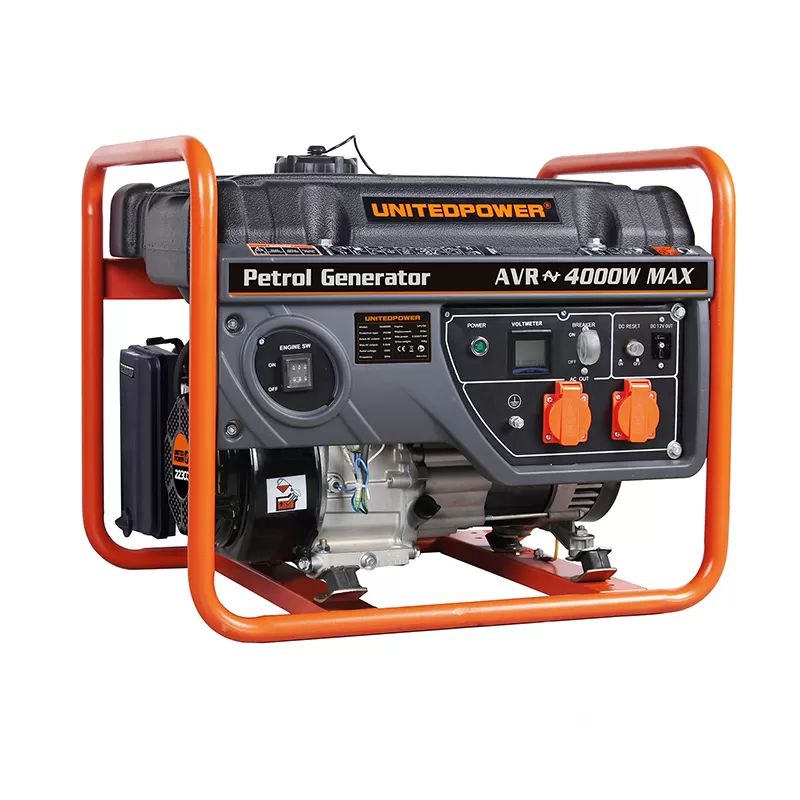
In the 4kW segment, engine displacement generally ranges from 212cc to 225cc for overhead valve (OHV) engines. Smaller engines running at maximum RPM consume fuel quickly and suffer premature thermal degradation. Industrial units sourced from manufacturers like United Power utilize cast-iron cylinder sleeves, forged crankshafts, and dual-stage air filtration to ensure longevity under continuous load.
Look closely at fuel consumption curves. A top-tier machine delivers between 8 and 14 hours of continuous operation on 3.5 to 4.0 gallons of gasoline at a 25% load state. Propane economy runs slightly lower on a gallon-for-gallon basis, averaging roughly 1.5 to 2.0 pounds of LPG per hour at 50% capacity.
Interface Layout and Panel Architecture
A dependable generator features an intuitive, well-protected interface panel. Essential connections include:
- NEMA TT-30R: The standard 120V 30-amp connection for travel trailers.
- NEMA L5-30R or L14-30R: Twist-lock outlets designed for transfer switches and worksite distribution boxes.
- Duplex 5-20R GFCI: Ground-fault protected household receptacles for standard appliances.
- USB-C Power Delivery (PD): Direct DC conversion ports delivering up to 65W or 100W for modern electronics without an external adapter brick.
Safety Standards and Atmospheric Monitoring
Carbon monoxide remains an acute hazard during portable power operations. Modern units increasingly feature active electrochemical sensors that automatically cut off ignition if ambient CO concentrations climb too high. Testing according to consumer safety frameworks led by groups like the National Institute of Standards and Technology (NIST) underscores the importance of these automated safety cutoffs.
4. Real-World Output and Bench Testing
Laboratory dyno runs differ sharply from job-site conditions. Environmental variables, ambient heat, and progressive load steps can diminish rated capabilities.
The "4000W" Label vs. Continuous Output
Buyers often mistakenly assume a 4 kilowatt generator runs indefinitely at 4,000 watts. In real-world generator load test assessments, a gasoline-powered unit rated at 4,000 surge watts typically hits thermal equilibrium at roughly 3,300 continuous watts. When running on propane, expect an additional 10% reduction in maximum output due to LPG's lower volumetric energy density.
Environmental Derating: Altitude and Ambient Heat
Naturally aspirated internal combustion engines lose power as atmospheric air density drops. According to standard engine rating metrics, such as ISO 3046-1, generators lose approximately 3.5% of their horsepower for every 1,000 feet gained above sea level, alongside an additional 1% drop for every 10°F above 77°F ambient temperature.
If you operate a 4kW unit in Denver, Colorado (elevation: 5,280 ft) on a hot 95°F summer afternoon, the engine suffers a loss of nearly 20% of its mechanical output. That rated 3,500-watt running limit drops to an actual continuous threshold of roughly 2,800 watts. Factoring these environmental variables into your sizing equation avoids unexpected operational halts.
Transient Step-Load Responses
During stress-testing protocols, we evaluate load-step response by applying instantaneous load blocks:
- Step 1 (0 to 1,500 Watts): Frequency fluctuates briefly between 59.2 Hz and 60.8 Hz, recovering within 0.4 seconds. Voltage remains stable at 120V (±2%).
- Step 2 (1,500 to 3,200 Watts): The engine governor opens the throttle instantly. Frequency drops to 57.5 Hz before stabilizing at 60.0 Hz in under 0.8 seconds.
- Step 3 (3,200 to 4,200 Watts - Peak Surge): The inverter
circuit runs in overload mitigation mode. Voltage drops slightly, and the engine
must sustain combustion without stalling for up to 5 seconds before protective
circuits trip.
5. Comparing 4kW Generator Architectures
Choosing the right machine involves weighing the distinct pros and cons of different formats, depending on whether you need it for construction, camping, or emergency home backup.
Open-Frame Worksite Models
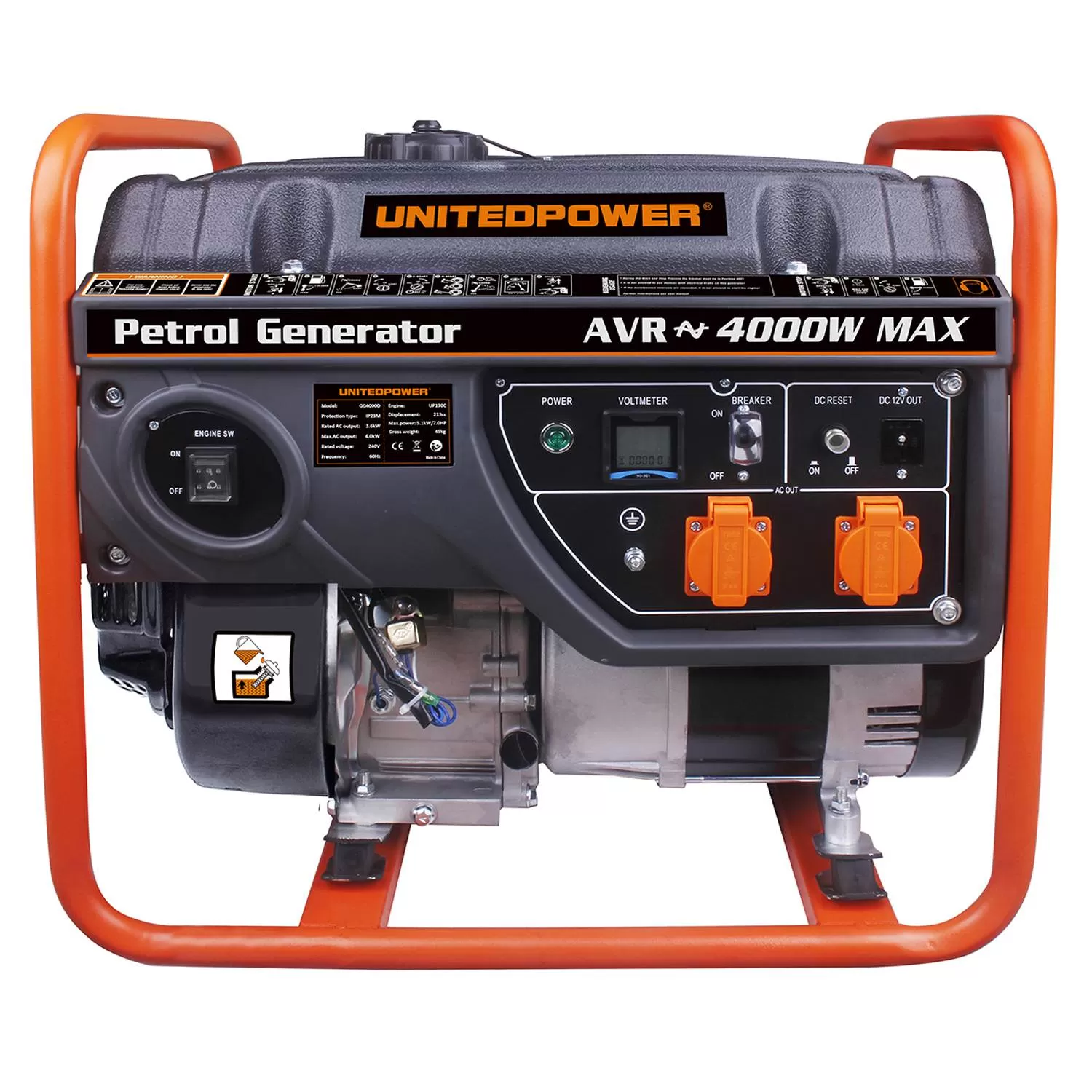
These units place the engine and alternator inside a tubular steel roll cage. They are durable, easy to repair, and cost-effective per kilowatt. However, they generate considerable noise (70-76 dB(A)) and use conventional alternators with higher THD levels. Choose open-frame designs for commercial construction sites, agricultural repairs, and remote property maintenance.
Fully Enclosed Inverter Models
Housed in acoustic composite shells, fully enclosed inverters are lightweight, whisper-quiet, and deliver clean utility-grade power. While they carry a higher price tag per watt and offer tighter engine compartments for maintenance, they remain the premier option for RV travel, glamping, tailgating, and residential neighborhoods during unexpected outages.
Frequently Asked Questions (FAQ)
Q1: Can a 4 kilowatt generator power an entire
house?
A1: No, a 4kW unit cannot run a whole home
with large central air conditioning, an electric clothes dryer, an electric
water heater, or an induction range. It will, however, power high-priority
survival circuits—such as your refrigerator, sump pump, gas furnace blower,
internet router, lights, and minor kitchen appliances—if managed with a manual
transfer switch.
Q2: How much fuel does a 4000-watt generator consume per
hour?
A2: Under a typical 50% load (around 1,750
watts), a modern 4kW inverter consumes roughly 0.25 to 0.35 gallons of gasoline
per hour. Under an identical electrical load, a dual-fuel unit running on
propane consumes approximately 1.2 to 1.6 pounds of liquid propane per hour.
Q3: What makes an inverter model different from an open-frame
unit?
A3: A standard generator runs at a fixed
3,600 RPM to maintain an alternating current frequency of 60 Hertz, regardless
of load. An inverter generator produces high-frequency, variable multiphase AC
power, converts it to DC, and finally inverts it into a pure sine wave. This
allows the engine to throttle down dynamically under lighter loads, lowering
fuel consumption and dampening engine noise.
Q4: Do I need to ground my 4kW generator every time I run
it?
A4: That depends on your site configuration. If
you plug appliances straight into the generator panel and the unit features a
bonded neutral design, an external ground rod is typically unnecessary under
OSHA and NEC rules. However, if you connect the generator to your home
electrical panel through a transfer switch, the system ground configuration must
match your home electrical setup. Always consult local electrical codes.
Q5: Can I parallel two 4 kilowatt generators for higher
output?
A5: Yes, provided both machines are
inverter models equipped with dedicated parallel ports and approved by the
manufacturer for combined operation. Hooking two identical 4kW units together
through a parallel kit delivers up to 8,000 surge watts and 7,000 running watts,
which provides enough juice to support large 50-amp RV setups and high-draw shop
equipment.
Procurement Considerations: Final Checklist
Before issuing a purchase order or signing off on your next equipment supply shipment, walk through these essential technical requirements:
- Confirm the real continuous running output on your preferred fuel source, accounting for high-temperature and altitude drops.
- Ensure the interface includes the exact outlet configurations your team requires, such as a TT-30R for travel trailers or an L5-30R for power distribution boxes.
- Confirm that total harmonic distortion stays strictly under 3% if you plan on powering telemetry equipment, computers, or sensitive electronic gear.
- Verify that local emissions and safety certifications, such as EPA, CARB, and auto-CO shutoff sensors, are present and current.
A dependable 4 kilowatt generator remains one of the most practical investments in reliable off-grid power. United Power supplies equipment buyers, plant managers, and equipment distributors worldwide with precision-built, field-tested generation platforms. Reach out to our technical engineering sales group today to discuss supply orders, custom fuel configurations, and international shipping options.